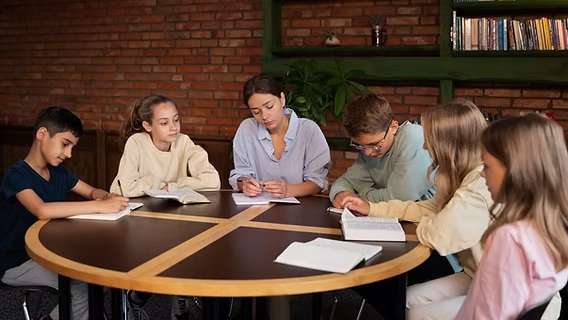
Education is often seen as an individual activity, but students can also learn a great deal by working with others. Group learning gives students an opportunity to exchange ideas, discuss problems, and work together toward a common goal.
Whether it takes place in a classroom, laboratory, workshop, or online environment, collaborative learning can introduce students to different ways of thinking. It also helps them develop communication and teamwork skills that can be useful beyond their education.
Learning From Different Perspectives
Every student approaches a subject differently. One student may understand a concept through examples, while another may find it easier to understand through diagrams or practical explanations.
When students work together, they can share these different approaches. A student who understands a topic well may explain it to a classmate, while another student may introduce a different way of solving the same problem.
This exchange can help make difficult subjects easier to understand.
Improving Communication Skills
Communication is an important part of group learning. Students need to explain their ideas clearly and listen carefully when others are speaking.
Group projects can encourage students to practice asking questions, giving explanations, presenting information, and responding respectfully to different opinions.
These skills are useful not only in education but also in future workplaces and everyday situations.
Developing Teamwork
Many real-world tasks require people to work together. Group learning gives students an early opportunity to understand how teamwork works.
A group project may require students to divide responsibilities, establish deadlines, and make decisions together. Each person may have a different role, but the final result depends on everyone’s contribution.
Through these experiences, students can learn that successful teamwork requires communication, reliability, and respect.
Building Confidence
Some students feel uncomfortable speaking in front of a large classroom. Working in a smaller group can provide a less intimidating environment for participation.
As students become more comfortable sharing ideas with classmates, their confidence may gradually increase.
Small group discussions can also give quieter students an opportunity to contribute ideas that they might not express during a larger classroom discussion.
Learning to Handle Different Opinions
People do not always agree, and group activities can teach students how to deal with differences respectfully.
A student may have a different solution or interpretation from another member of the group. Instead of treating disagreement as a problem, students can learn to explain their reasoning and consider the evidence behind another person’s position.
This can encourage open-mindedness and thoughtful discussion.
Developing Problem-Solving Skills
Group activities often involve problems that require several ideas before a solution can be found.
Students can brainstorm possible approaches, compare their advantages and disadvantages, and decide which option to try.
If the first solution does not work, the group can discuss what went wrong and develop another approach. This process gives students practical experience with problem-solving.
Encouraging Responsibility
Group projects work best when every student contributes. This creates an opportunity for students to develop a sense of responsibility.
When a student is assigned a specific task, other members may depend on that work to complete the larger project. Meeting deadlines and completing responsibilities therefore become important parts of the learning experience.
Teachers can support this process by assigning clear roles and helping students understand how individual contributions affect the group.
Combining Group and Individual Learning
Group learning does not need to replace individual study. Both approaches can serve different purposes.
Individual study allows students to work at their own pace and focus on areas where they need additional practice. Group learning, on the other hand, provides opportunities for discussion, collaboration, and shared problem-solving.
Combining both approaches can give students a more balanced educational experience.
Technology and Collaborative Learning
Technology has expanded the possibilities for group learning. Students can collaborate through online classrooms, shared documents, video meetings, discussion platforms, and educational applications.
These tools can be especially useful when students cannot meet in the same physical location.
However, technology should support meaningful collaboration rather than simply providing another communication channel. Students still need clear goals, responsibilities, and opportunities to contribute.
The Teacher’s Role
Teachers play an important role in making group learning effective. They can create appropriate activities, explain expectations, assign responsibilities, and monitor student participation.
Teachers can also help resolve problems when group members disagree or when some students are contributing less than others.
Good guidance allows students to focus on learning while gradually developing the skills needed to work independently with others.
Final Thoughts
Group learning can provide students with more than academic knowledge. It can help them communicate clearly, listen to different perspectives, solve problems, share responsibilities, and work toward common goals.
When combined with individual study and effective teacher guidance, collaborative learning can create a richer educational experience.
The ability to learn with others is a valuable skill that students can carry with them from the classroom into higher education, professional environments, and everyday life.
Leave a Reply